

How position is assigned
In each answer, Echod finds every brand that is named and ranks them by where they first appear in the text. The first brand named gets position 1, the second gets position 2, and so on. Every brand counts toward that ranking, not just the ones you track. If an answer names three brands you do not track before your own, you are at position 4.How it is calculated
Example
In the last 7 days your brand was named in four answers, at positions 1, 2, 2 and 5.Reading it
- Lower is better. Position 1.0 means you are always named first.
- A falling number is an improvement. In Echod, a drop in Average Position shows as a positive (green) change.
- A brand that was not named has no position. In tables, such as Top Brands, it shows -.
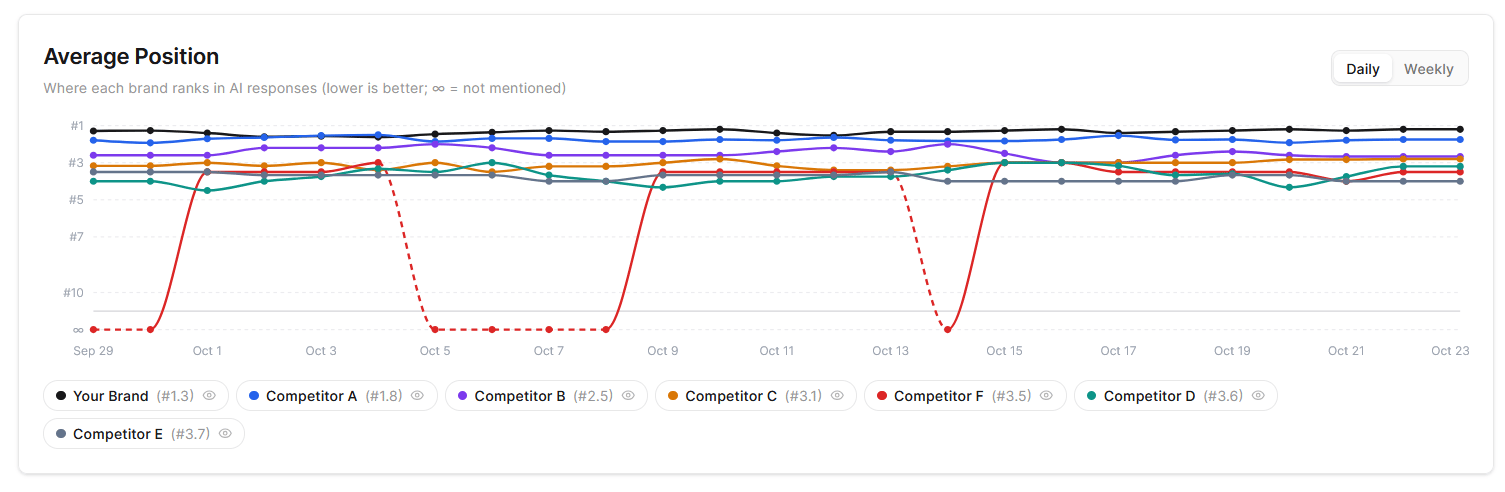
- On the Average Position chart, the bottom of the scale is marked ∞. When a brand has a position on some days but was not named on others, its line drops to ∞ on those days, and hovering shows “Not mentioned”. A brand that was not named at all in the period gets no line.
Where you see it
- Dashboard: the Avg Position row in the Score breakdown.
- Topics and Prompts lists: the Position column.
- Topic and prompt detail pages: an Average Position chart for each tracked brand.
Put it to work
- Pair Average Position with Visibility. Good visibility with a poor position means AI platforms know you but do not lead with you; look at what the answers say about the brands ranked ahead.
- Position can shift when a new brand starts appearing in answers, even if nothing changed for you. If your position worsens suddenly, check for newly discovered competitors.
- Prompts that ask for comparisons, alternatives or “best” lists produce the most meaningful positions. Make sure your setup includes some of them. See Prompts.